Compare what appeared
The view shows observable differences without claiming access to a platform’s private ranking formula.
EXAMPLE BUYER PROMPT“Which nearby provider best fits this need, and what supports that choice?”
- Google search84
- AI answers68
- Authority73
- Social61
Example VisibleGen workspace using demonstration data. It does not represent a customer account or a published study result.
The short answer
Competitors may appear first because they are closer to the searcher, their business details are clearer, their website answers the question better, or more trusted sources support them. The reason can differ between Google Maps and an AI answer, so inspect the result and its sources before deciding what to fix.
Seeing a competitor above you is frustrating. The first reaction is often to add keywords, buy links, or copy the competitor’s page. That can waste time when you have not identified the real gap.
Maps and AI answers work differently
Google says local results are mainly based on relevance, distance, and prominence. Read Google’s local ranking guidance.
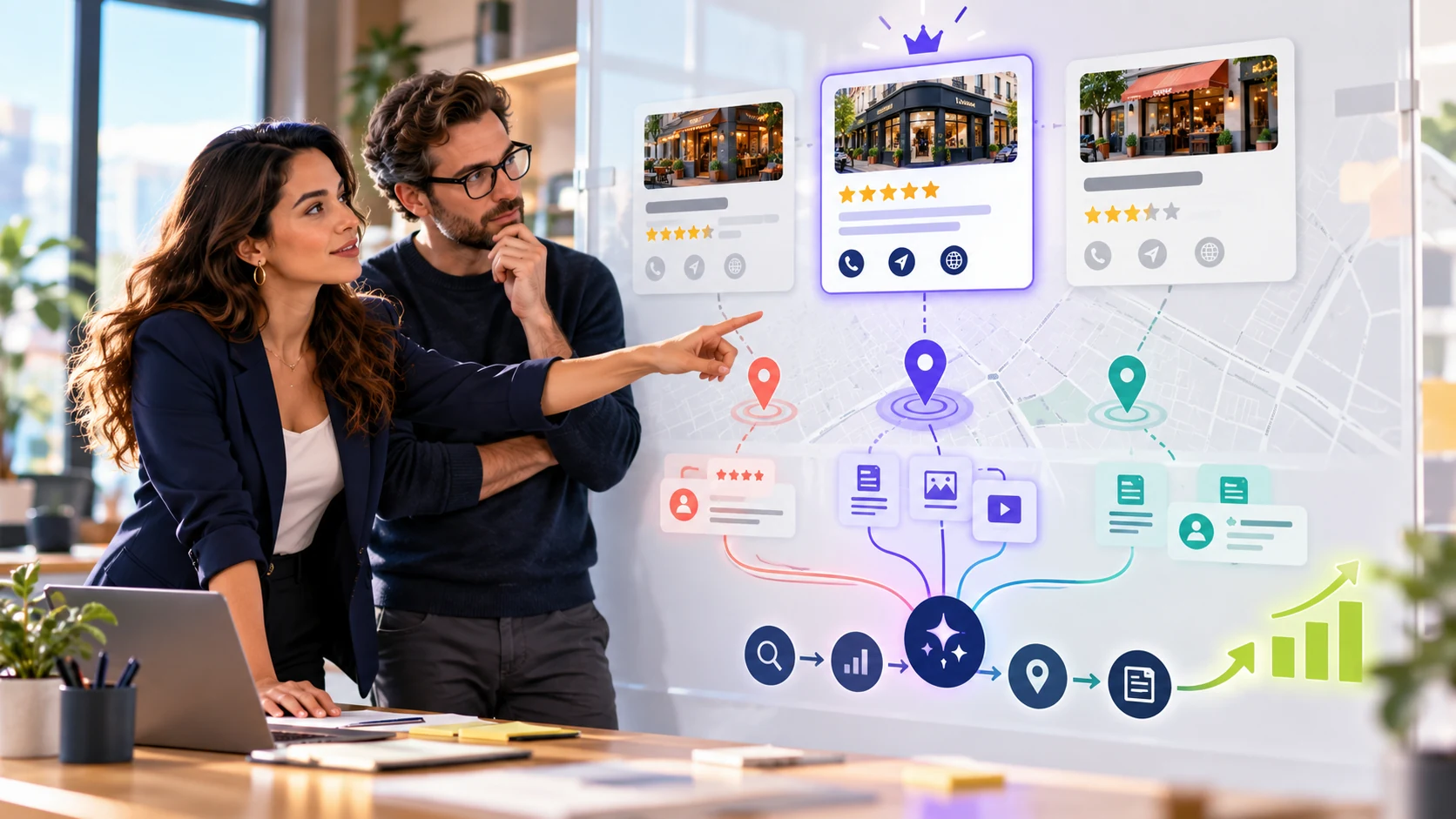
AI answers may combine search results, business profiles, directories, articles, reviews, and other public sources. They may name several businesses and explain why each could fit. A competitor can therefore lead on the map but be missing from an AI answer, or the other way around.
Reason 1: your wording does not match the customer’s
Customers rarely use the exact words in your menu. A company might call its service “workplace wellbeing support,” while customers ask for an “employee mental health program.” If the page never connects the two, it may be less clearly relevant to that question.
Write for customers first. Use their words, then explain the proper service name without repeating phrases unnaturally.
Reason 2: your public details disagree
An old address, a different category, or two versions of the company name create doubt. Check your website, Business Profile, major directories, social profiles, and industry listings. Correct what you control. Never create false profiles or duplicate locations to appear larger.
Reason 3: the competitor explains the choice better
Open the competitor’s useful page. Can a customer quickly see who the service is for, where it is available, how it works, and what to do next? Are there real examples or named experts?
Ask the same questions about your page. Better content is not necessarily longer. It is clearer.
Reason 4: other sources support the competitor
Reviews, local news, associations, partner pages, and independent articles can help people understand a business. If an AI answer cites a directory or publication, inspect it. Is your business missing? Is the information old? Is there a genuine reason your company should be included?
Reason 5: they are simply closer
For local searches, distance is a real limit. Focus on the areas you serve well, make genuine service areas clear, and never invent addresses.
A worked example: four businesses, four descriptions
In the saved Ichhra check, ChatGPT presented Shop A first with a clear street address and bird-focused wording. Shop B had the largest review count shown and was framed around feed. Shop C had a 5.0 rating from two reviews, which the answer treated as limited support. Shop D was last, with no confirmed address or reviews shown.
Those are the reasons stated in that answer. They are useful clues, but they do not prove the system’s private ranking process or establish a permanent order.
Turn the comparison into a short work list
- Business details to correct.
- Website information to improve.
- Customer proof to earn honestly.
- Relevant third-party coverage to pursue.
Then fix the clearest, most valuable gap first.
VisibleGen Radar places selected local and AI discovery checks in one report so teams can inspect what appeared and which sources were shown. Radar is available with Agency and Enterprise. It does not claim to reveal a search engine’s private ranking formula.
What to do next
Pick one important customer search. Compare your business with the names shown on the map and in available AI answers. Write down three differences you can verify, then fix the one that makes your business easier for a customer to understand.
Read the Google Maps visibility guide and the AI visibility tracking guide next.